GomeraVerde.com
La Gomera is a piece of paradise in the middle of the Atlantic. Green and round, endearing and full of history. It was the last land stepped on by Columbus before coming to America and is the island where the phrase 'Give me a silbidito' has an explicit meaning.
The way of communicating dates back to aboriginal times and its charm in abundance make La Gomera, the ideal place for a perfect getaway.
Some travelers take the secondary roads in their cars. Their map, has suddenly become a mystery and they do not know in what area they are located. "Sorry, it's small, where are we?" The child, which carries a stick in one hand and a shadow in the shape of hairy dog at his feet, responds, looking surprised: "En La Gomera". Foreigners then ask for a littlemore detailed information. "Ah en Chipude", says the muchachillo thinking, surely: "Where would you be?" This anecdote, which, I would say , is true also became reality, This summarizes the nature of the language of the people, without a doubt, this the best Columbian Island, which has no single corner that is not worth visiting.
The first thing that comes to mind when thinking of La Gomera, in addition to the silbo, is its lungs. The Laurel: of the Garajonay National Park. The lushness of the vegetation is impressive. Moisture suspended between the Heathers, the fayas and the barbuzanos gives it a mysterious aspect that fires the imagination. There is no price to pay to pass through tunnels carved in the stone that distills drops of water as if it were the giant stack of a Canary Island House. The Park is filled with delicious, silent, trails in which nature has written it's own story, a story that has little or nothing to do with the story written by the Aboriginal people of the island.
Map in hand and well equipped with plenty of water and a sandwich it is time to explore this fascinating island. But there are other things offered here, including the gastronomy. As a main dish, the almogrote, a cream-based cheese that is spread and can be enjoyed as an aperitif. Honey from the palm trees, delicacy which exists thanks to the guaraperos, do not miss it.
The beach of Playa de Santiago Santiago is the choice for those who cannot live without their ration of salt and black sand. "The spirit language", as it is called many of those who return every year, permeates every corner. It is that spirit which marks the tranquility that speak of the island inhabitants, and calm with which they live and moving, but is also the same spirit which lives under the leaves of Laurel in the Garajonay, the calm which contributes to the entire park with the appearance of magic and haunted, territory to charm visitors.
Las Vistas

Las Vistas Apartments
Wednesday, 8 June 2011

Monday, 30 May 2011
Playa de Santiago - Blue Award for Beach

There are two beaches that had the recognition during 2010 and that have not been renewed this summer, which are those of La Laja (Las Palmas) and the Meloneras (San Bartolomé de Tirajana) in Gran Canaria.
Tenerife lost three beaches with the blue flag status, Leocadio Machado (Granadilla), El Socorro (Los Realejos) and Playa Jardín (Puerto de la Cruz), while the award retained the beaches of El Médano, La Tejita, Las Vistas (Mesa del Mar), El Camisón, Troy and Santiago del Teide.
The island of La Gomera got its only blue flag which is the beach of Playa de Santiago, in the municipality of Alajero.
Another newly awarded blue flag was the beach of Las Playtas on Fuerteventura. This island now becomes the second of the Canary Islands with more eight blue flags. Lanzarote and La Palma retained the same number of beaches with the blue flag, five and four respectively.
Thursday, 12 May 2011
La Gomera - History
HISTORY: Inhabited by ‘Guanches’ of Berber origin until the arrival of the Spanish conquistadores in the 15th century, La Gomera is famous for being the final stop Christopher Columbus made to rest and take on supplies before discovering America. Ever since, the constant flow of emigration to the new world, especially to Cuba and Venezuela, has given the island a distinctly Latin American feel. It has a population of 17,000 many of whom farm the ingeniously terraced slopes of the greener and more fertile north producing fabulous crops of vegetables, citrus and tropical fruits. The valley floors are often covered with banana plantations and there are palm trees everywhere, more here, we are told, than in all the other Canary islands put together.
La Gomera appeals most of all to those who wish for a relaxing holiday in the sun where they can enjoy what nature offers, be it sunbathing or swimming in the sea at any time of year, walking or hiking around its stunning interior or enjoying a simple meal of freshly caught fish washed down with local wine.

This spectacular island is crowned by the renowned ‘laurisilva’ forest and has been declared a World heritage Site by UNESCO. La Gomera’s highest point is the Alto de Garajonay at 1485 metres (5000 ft approx). In fact, the island has hardly any flat land at all, making it seem much larger than it is and ruling out the viability of high rise tourist developments. Deep ravines cut into the island from the centre to the perimeter. Each ravine or ‘barranco’ is a world of its own, cut off from its neighbours by the steep slopes of the valley sides. Ancient goat paths and tracks criss-cross the countryside, making it a walker’s paradise. For the more adventurous, scuba diving and mountain biking can also be enjoyed as well as boat trips to see round the island or watch the dolphins and whales that congregate off shore.
The Gomeran people realise thy live in a special place and are keen to preserve the natural beauty of the island and their tradtional way of life. You may be lucky enough to experience a local fiesta and dance the night away to live latin music in the village square, to join in a religious procession accompanied by musicians playing their traditional intruments, the 'tambor' and 'chacaras'. or even to hear the Gomerans comminicating in their unique whistling language "el silbo". Whatver your activity you will be made welcome by the easy-going Gomerans.
Playa de Santiago - Bus Timetable
Playa de Santiago - Buses
From Playa de Santiago to San Sebastian
Monday > Saturday
Sundays & Public Holidays
From San Sebastian to Playa de Santiago, Alajero and Imada
Monday > Saturday 10.30
Sundays & Public Holidays
From the Airport to San Sebastian
Monday > Thursday
Fridays
Saturdays
Sundays & Public Holidays
n.b. The bus will not run if flights are cancelled.
If a flight is delayed the bus will also be delayed
From the Airport to Valle Gran Rey
Monday > Thursday
Fridays
Saturdays
Sundays & Public Holidays
Buses to the north of the island all run from the bus station in San Sebastian
More information of the island’s buses http://www.la-gomera.com/autobus.htm
Tuesday, 10 May 2011
La Gomera
La Gomera http://www.la-gomera.co.uk/
Location: In thePosition: 20 miles West of the
General Description: Smallest and oldest of the 7
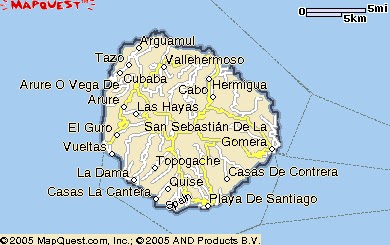
PLAYA de SANTIAGO is a small working fishing port on the South coast which gets lots of sun and although slowly developing is otherwise quiet and unspoilt. Alongside the harbour-side are several restaurants offering local cuisine where you can while away the hours watching the fishing boats unloading their catches. The village offers a modern medical centre, an excellent bakery, two banks, a pharmacy, dentist, post office, two hair/beauty salons, two grocery shops and some local craft/gift shops plus a stationery/newsagents’ shop. To the West of the village lies the island airport, here only small aircraft can land and there are two flights daily to Tenerife . The largest hotel on the island, Hotel Jardin Tecina, which has an 18 hole golf course, is situated on a headland at one end of the village. Here you may enjoy the hotel entertainments or sample one of the five restaurants, which offer a variety of local and international dishes. Development on the island is strictly regulated and any new buildings within the village blend in with the traditional architecture and dramatic cliffs which act as a backdrop
San Sebastian, Valle Gray Rey and Vallehermoso
VALLE
VALLEHERMOSO is located on the southwestern and northwestern coasts of the island. Its capital, the town of Vallehermoso on the north coast, is linked with a main highway encircling every part of the island and is located WNW of the island capital, San Sebastián de la Gomera. Vallehermoso is the second largest municipality in the area. Farmlands are in the valley areas and the mountains and the hills dominate the inland areas. Part of the area is made up of farmlands, while the mountainous areas are forested or grassy. The main industries are agriculture and tourism. The area is also famous for its miel de palma (palm honey), as well as tomato, potato and banana production. The municipality features a rock-formed mountain Los Organos which is made up of basalt rocks. Mountaintops include El Cercado and La Fortaleza or Chipude. The natural beauty of the mountain area forms a part of the Garajonay Park. Directly on the coast of Vallehermoso is an interesting feature, a cultural centre named El Castillo del Mar, located in an old banana factory which was used until 1950 as a centre for concerts, cinema and folklore music. Due to severe gales the road to El Castillo is currently impassable.
Saturday, 7 May 2011
Subscribe to:
Posts (Atom)